
Five Cinematic Techniques You Can Use in a Single Photograph
A film-maker has a hundred years of accumulated tricks, a crew, and the budget to build whatever the shot needs. You have a camera and an afternoon.
That sounds like a disadvantage until you notice that most of what they do is not spending. It is deciding — where the light comes from, what colour the thing is, what you can see and what you cannot. Those decisions are free, and every one of them works in a single frame.
Here are five worth borrowing.
1. Motivated light
In film, light is supposed to come from somewhere the audience can believe in. A window, a lamp, a fire, a phone screen. It is called motivated lighting and it is the difference between a scene and a set.
Photographs give themselves away in exactly the same way. A face lit evenly from the front by a pop-up flash has no story in it, because that light does not exist anywhere in the world.
How to use it: before you take a portrait indoors, find the light that is already there and put your subject in it. A window on one side. A lamp behind them. Whatever it is, let the picture explain itself.
2. Chiaroscuro, or: let it go dark
Painters worked this out first and film borrowed it wholesale. Chiaroscuro is the deliberate use of deep shadow against small, hard-won light, and its whole power comes from what you cannot see.
The instinct with a modern camera is the opposite — recover the shadows, lift the blacks, get detail everywhere. Resist it. Detail everywhere is a document. Detail in one place is a photograph.
How to use it: expose for the brightest part of your subject and let the rest fall away. On the back of the camera it will look too dark. Look again on a proper screen before you decide.
3. One palette, held
Watch any film with a strong look and you will notice how few colours are actually in it. Two, usually, and a third for the moments that matter. The teal-and-orange thing everyone complains about is a lazy version of a real principle.
A photograph with four competing colours has no mood at all. It just has stuff in it.
How to use it: pick your dominant colour before you shoot, not after. Then look round the frame for anything that fights it — a red bin, a yellow sign, somebody’s blue coat — and either move, or move it, or wait for it to walk off.
4. Frame within the frame
Doorways, arches, mirrors, windows, gaps between buildings. Film uses them constantly: you are looking at the subject through something, and that something tells you where you are standing and how you feel about it.
It does two jobs at once. It cuts out the clutter round the edges, and it puts the viewer somewhere specific rather than nowhere.
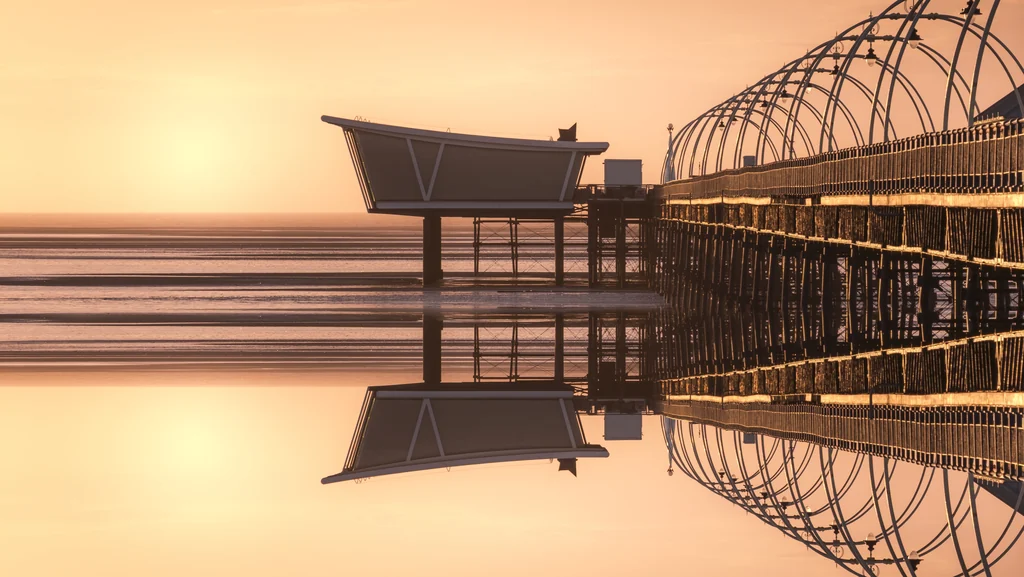
How to use it: take a step back and look for something to shoot through. Round here it is the pier ironwork, an arch, or the gap between two beach huts. The frame does not need to be complete — half an arch on one side will do it.
5. The locked-off shot
The hardest one to learn. Put the camera on a tripod, decide the frame, and then do not touch it. Let the world move through the rectangle instead of chasing it.
It forces you to compose properly, because you cannot rescue a weak frame by swinging the camera. And it changes how you wait: you stop hunting and start watching for the moment when the frame fills up correctly.
How to use it: find your composition first, with nothing in it. Then wait for the person, the bird, the wave. It takes patience and it produces the pictures you are proudest of.
The one that ties them together
Every one of these is a decision made before you press anything.
That is the honest lesson from film. The crew, the money and the kit exist to deliver a decision that somebody made in advance, sitting down, with a pencil. You can make the same decision on a walk, for nothing, and it will do just as much work.
If you want the videos these came out of, here are nine worth watching.
Thanks for reading. If it was useful, come and say hello — I post the photographs that do not make it onto here, and I answer everything.
— Stephen